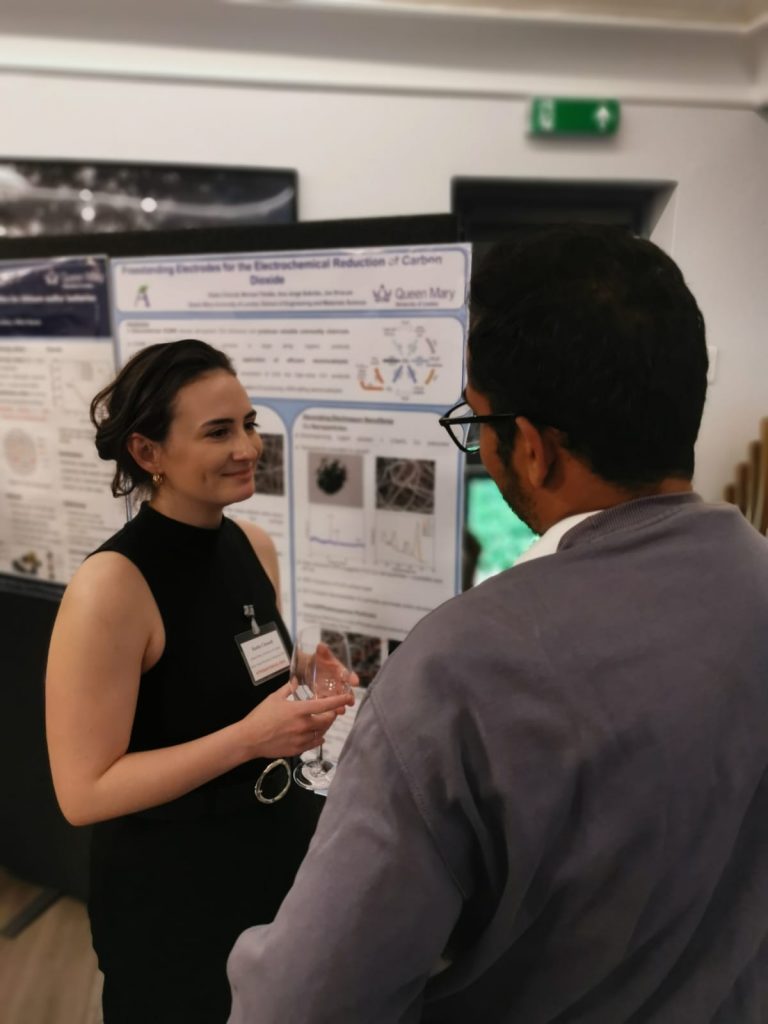
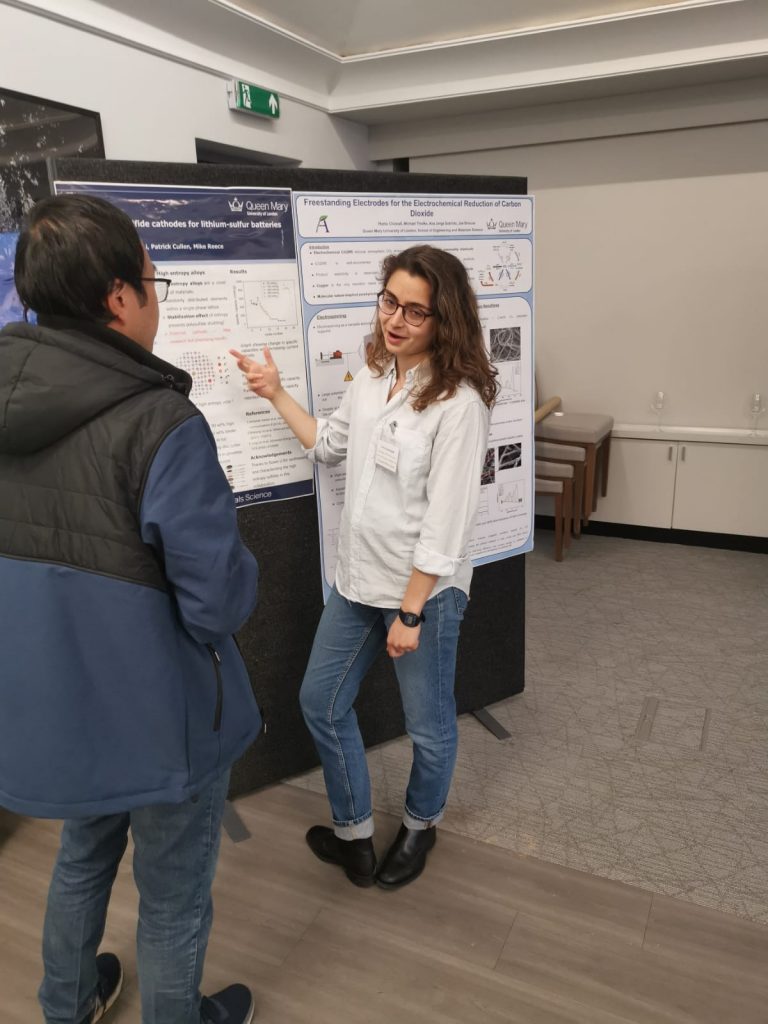
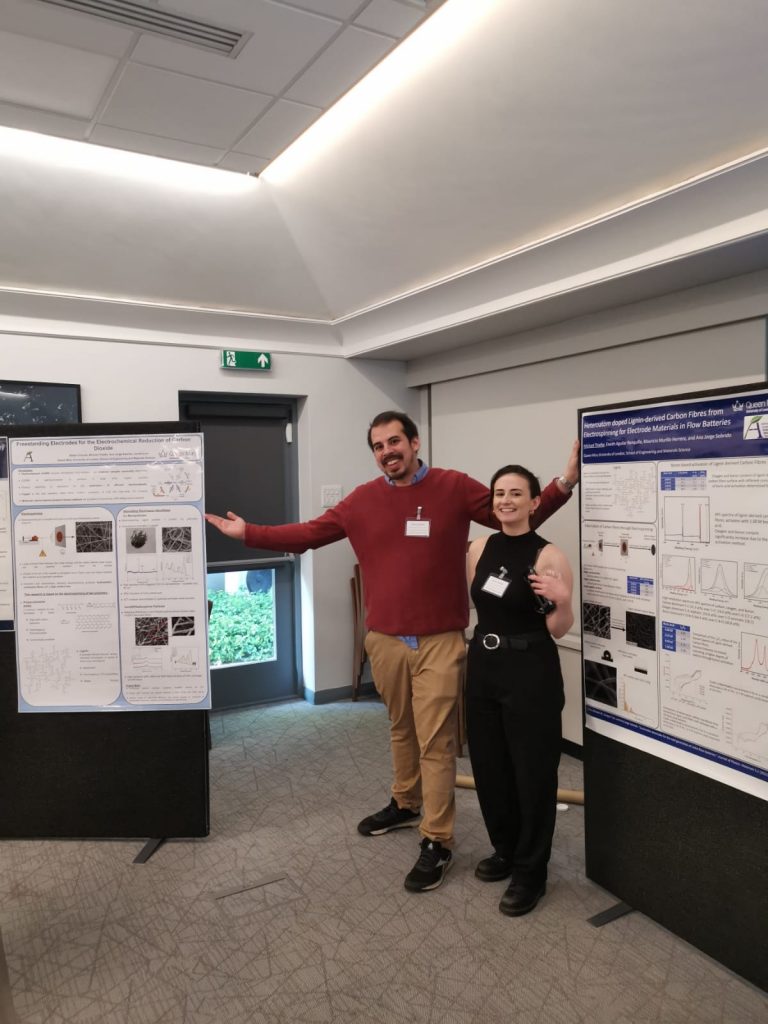
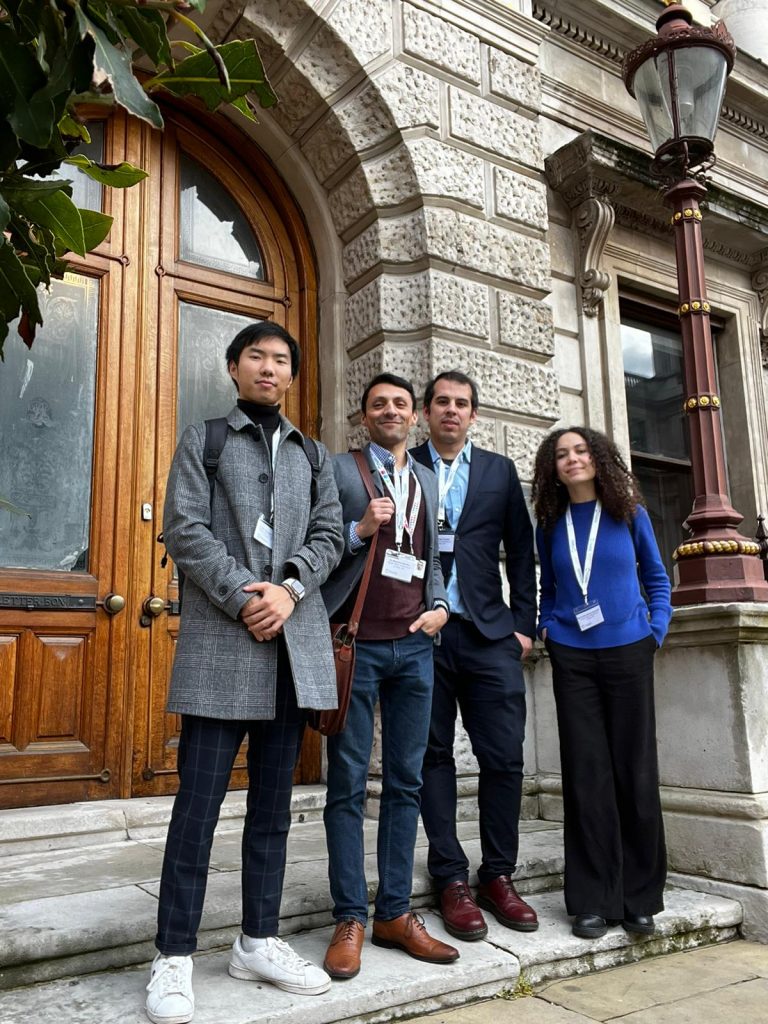
Hattie, Lara and Michael had a great time at the STFC Battery Annual Meeting for Early Career Researchers held in Abingdon. They all shared their work in new materials for energy storage and electrocatalysis.

A. Jorge Sobrido´s Research Group
Advanced Energy Materials Group
Hattie, Lara and Michael had a great time at the STFC Battery Annual Meeting for Early Career Researchers held in Abingdon. They all shared their work in new materials for energy storage and electrocatalysis.


The group enjoyed a well-deserved day out hiking in Epping Forest. It was a gorgeous day!


Ana gave a talk at the CIC Energigune in Vitoria, Basque Country. She enjoyed the visit to the centre, the impressive facilities and knowing more about the research conducted there, in particular in the area of electrochemical energy storage. It was great to get to see Montse Cabanas again after so long since they both shared office at ICMAB, and also Stiven who is doing a PhD in recycling Li-ion batteries at CIC Energigune.
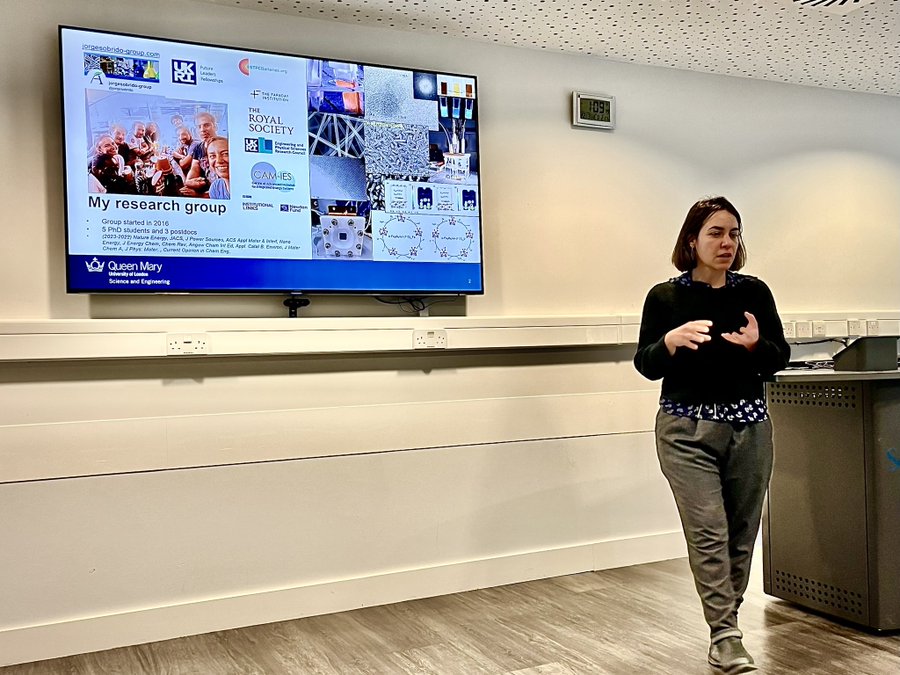
Ana was invited by Dimitra Georgiadou from University of Southampton to share her and her team work on redox flow batteries. It was great to see the facilities there and discuss science with the attendees. Thanks for the invitation!
Surface Modification of PAN-Derived Commercial Graphite Felts Using Deep Eutectic Solvents for their Application as Electrodes in All-Vanadium Redox Flow Batteries
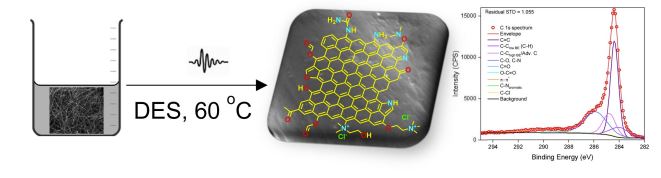
Mauricio, Eneith and Michael published this great work on modification of carbon felts for redox flow battery applications, using deep eutectic solvents to modify the surface chemistry of the commercial fibre electrodes.
Abstract.
All-vanadium redox flow batteries are promising large-scale energy storage solutions to support intermittent
power generation. Commercial graphite felts are among the most used materials as electrodes for these batteries due to their cheap price, high conductivity, and large surface area. However, these materials exhibit poor wettability and electrochemical activity towards vanadium redox reactions, which translates into overpotentials and lower efficiencies. Deep eutectic solvents (DES) are mixtures of Lewis acids and bases that exhibit lower melting points than their original components. Here, a DES composed of choline chloride and urea, and a DES composed of FeCl3 and NH4Cl have been
employed to modify the surface of graphite felts alongside a series of re-carbonization steps. The resulting materials were compared against pristine, thermally activated, and oxidatively activated graphite felts. Our results indicated that the treatments introduced new oxygen and nitrogen functionalities to the carbonaceous surface and increased the surface area, the degree of disorder and defects in the graphitic layers of the fibres. Cyclic voltammetry studies demonstrated higher electrochemical activity towards vanadium redox reactions and electrochemical impedance spectroscopy experiments showed the modified materials exhibited significantly lower charge transfer resistances. When tested in full cell configuration the electrode modified with the urea-based DES exhibited comparable coulombic efficiencies and superior energy storage capacity retention than the thermally oxidized felt used as benchmark, suggesting that the introduction of oxygen- and nitrogen-rich functional groups had a positive effect on the overall electrochemical performance of graphite felts.
Single-Atom Iridium on Hematite Photoanodes for Solar Water Splitting: Catalyst or Spectator?

Qian Guo is the first author of one of the latest publications in the group on photoanodes for water splitting. Well done Qian!
Abstract. Single-atom catalysts (SACs) on hematite photoanodes are efficient cocatalysts to boost photoelectrochemical performance. They feature high atom utilization, remarkable activity, and distinct active sites. However, the specific role of SACs on hematite photoanodes is not fully understood yet: Do SACs behave as a catalytic site or as a spectator? By combining spectroscopic experiments and computer simulations, we demonstrate that single-atom iridium (sIr) catalysts on hematite (α-Fe2O3/sIr) photoanodes act as a true catalyst by trapping holes from hematite and providing active sites for the water oxidation reaction. In situ transient absorption spectroscopy showed a reduced number of holes and shortened hole lifetime in the presence of sIr. This was particularly evident on the second timescale, indicative of fast hole transfer and depletion toward water oxidation. Intensity-modulated photocurrent spectroscopy evidenced a faster hole transfer at the α-Fe2O3/sIr/electrolyte interface compared to that at bare α-Fe2O3. Density functional theory calculations revealed the mechanism for water oxidation using sIr as a catalytic center to be the preferred pathway as it displayed a lower onset potential than the Fe sites. X-ray photoelectron spectroscopy demonstrated that sIr introduced a mid-gap of 4d state, key to the fast hole transfer and hole depletion. These combined results provide new insights into the processes controlling solar water oxidation and the role of SACs in enhancing the catalytic performance of semiconductors in photo-assisted reactions.
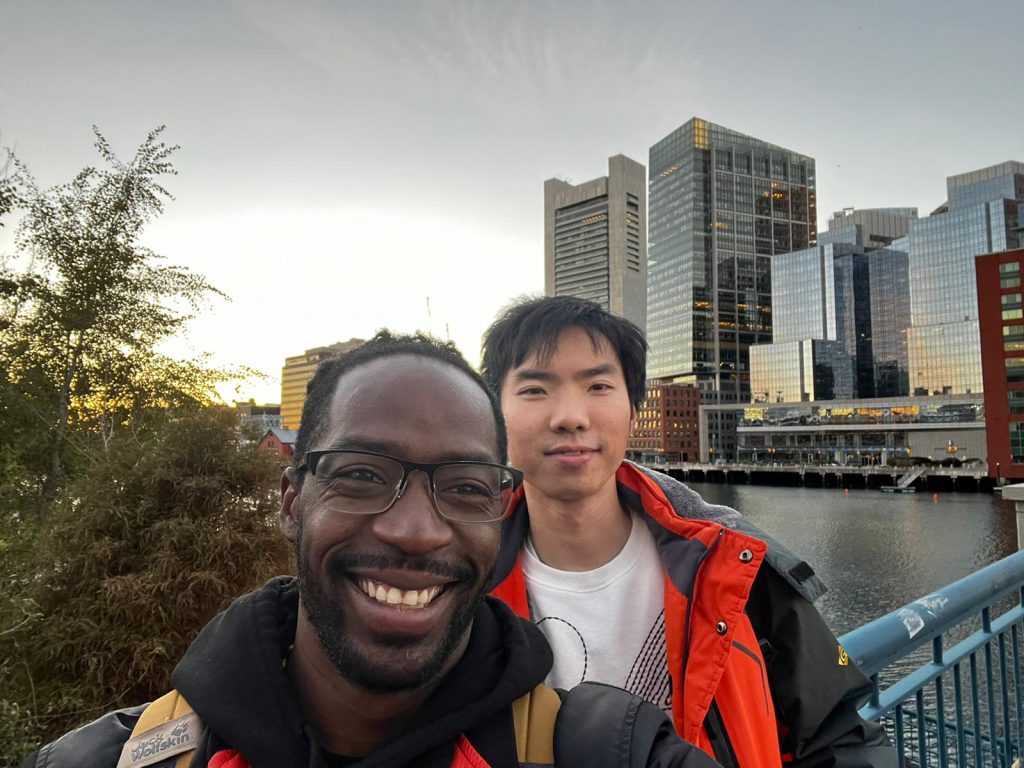
Carlos and Gengyu have just arrived in Boston! They are both giving talks at the MRS Fall; Carlos will be presenting his work on spin selectivity in oxygen electrocatalysis and Gengyu, his work in solar redox flow batteries. After that, they will be spending a couple of weeks at the MIT Chemical Engineering Department, working in the group of Prof Brushett, as part of our joint grant on redox flow batteries funded by The Royal Society International Exchanges.
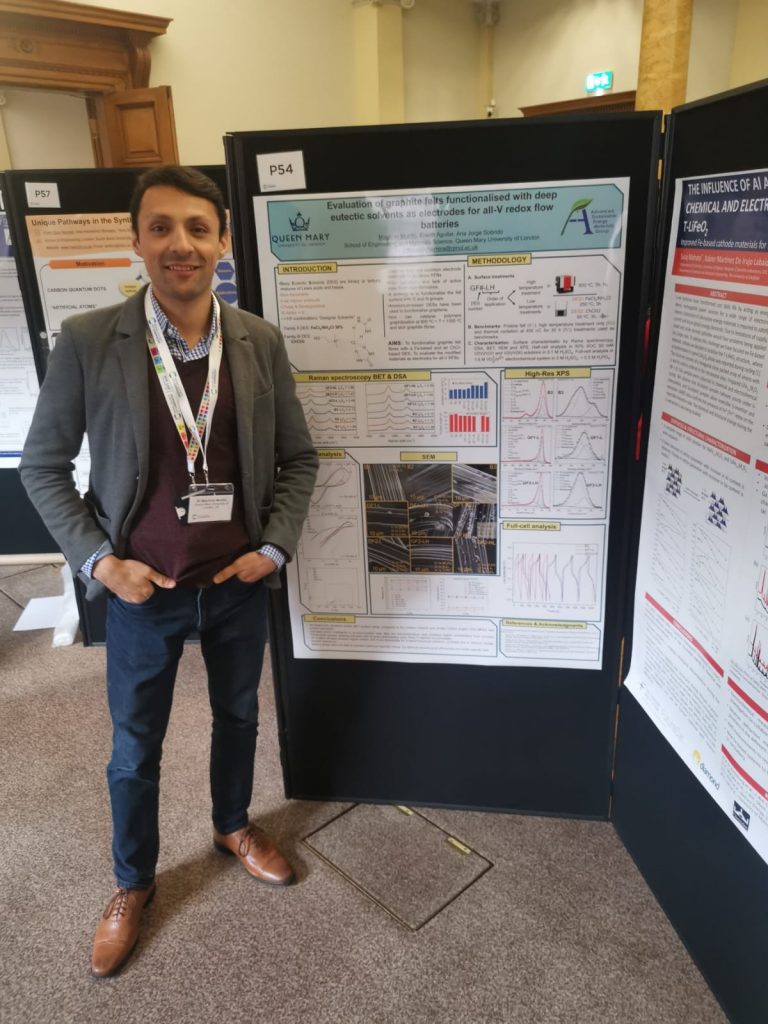
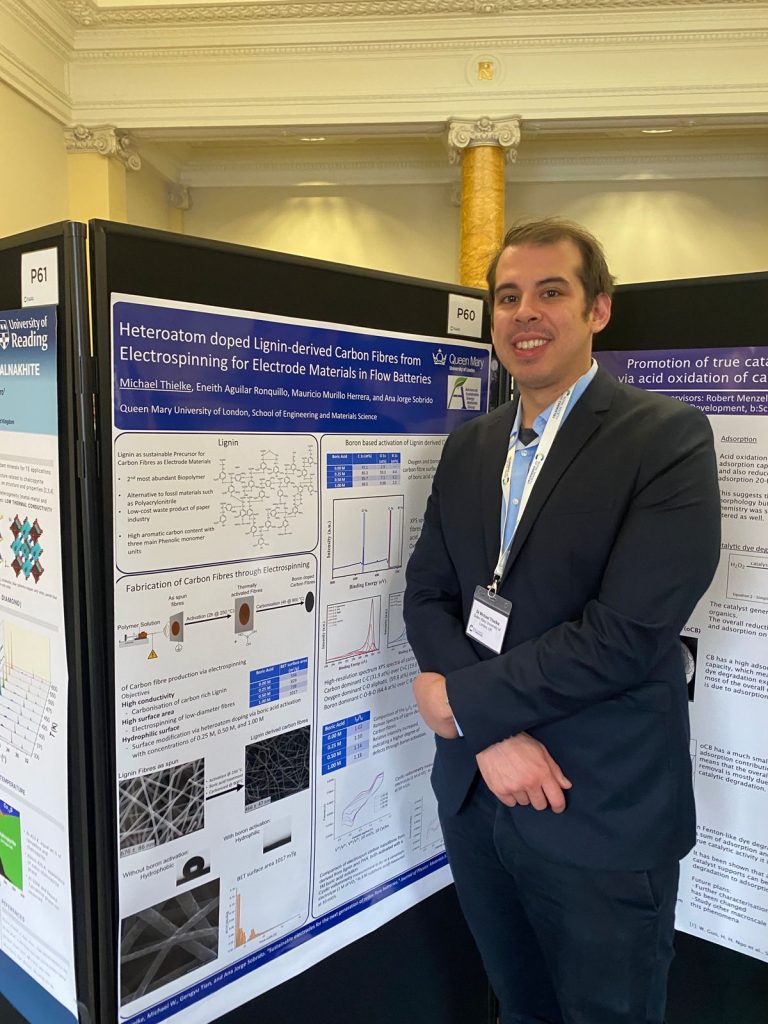
Eneith, Gengyu, Mauricio and Michael participated in the RSC Poster Symposium held on the 17th November 2022. Well done everyone in presenting some of our work done on redox flow batteries!
Ana Jorge Sobrido participated in the two-day residential crucible programme organised by FLF Development Network, at the Wood Hall Hotel in Wetherby.
The programme is designed to foster collaborations between researchers and introduce new ways of thinking and working, to form interdisciplinary, cross-sector networks between researchers who normally do not get the chance to meet.
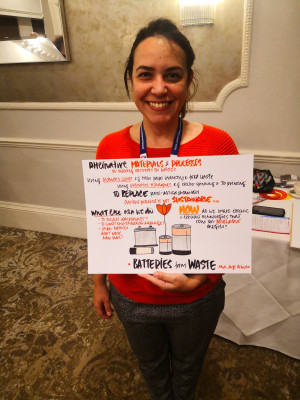
Welcome to Oliver Bramma who has joined the group to do a PhD in computational studies for redox flow batteries. Oliver will be investigating how to enhance electrocatalytic activity of carbon electrodes via surface chemistry modification using molecular dynamics modelling. We hope you enjoy this new stage Oliver!