
Ana participated in the N.I.C.E. Conference, held during the 14th to 17th October 2018 in Nice. She gave a talk on biomass-derived electrodes for supercapacitor applications and redox flow batteries.

A. Jorge Sobrido´s Research Group
Advanced Energy Materials Group
Ana participated in the N.I.C.E. Conference, held during the 14th to 17th October 2018 in Nice. She gave a talk on biomass-derived electrodes for supercapacitor applications and redox flow batteries.

Very happy to find out that our Newton Institutional Link collaborative project with Magda Titirici, from QMUL and Diana Lopez from Universidad de Antioquia on “Colombian Waste Biomass to Advanced Energy Materials” has been shortlisted for the Newton Prize, British Council.

Welcome to Gengyu Tian, who has recently joined the group to conduct a CSC PhD on new materials for energy storage applications. You can find out more about him here.

Welcome to Lian Grogan!
Lia is an undergraduate research assistant who will be working with Dr. Ana Sobrido’s group for a period of two months until November 2018. She is in the final year of a four year degree at Trinity College Dublin (B.A. Mod. in Nanoscience, physics and Chemistry of Advanced Materials). Her project focuses on the fabrication and analysis of lignin derived freestanding carbonaceous electrodes for use in Vanadium redox flow batteries. She is happy to be working in an area of sustainable materials development, as she considers a move towards a low carbon energy future to be of critical importance. She hopes to graduate in 2019.

Maria showed her work at the Royal Society of Chemistry Energy Materials for a Low Carbon Future Conference, held during the 17th and 18th September 2018, at The Royal Society, London, 6-9 Carlton House Terrace, London, SW1Y 5AG. She contributed to the meeting with a poster and also a flash presentation.

Congratulations to Qian, who won the Prize for the best poster at the Royal Society of Chemistry Symposium: Nanotechnology for Energy and Environment, held on the 6th and 7th of September 2018 at The Royal Society of Chemistry, Burlington House, London.
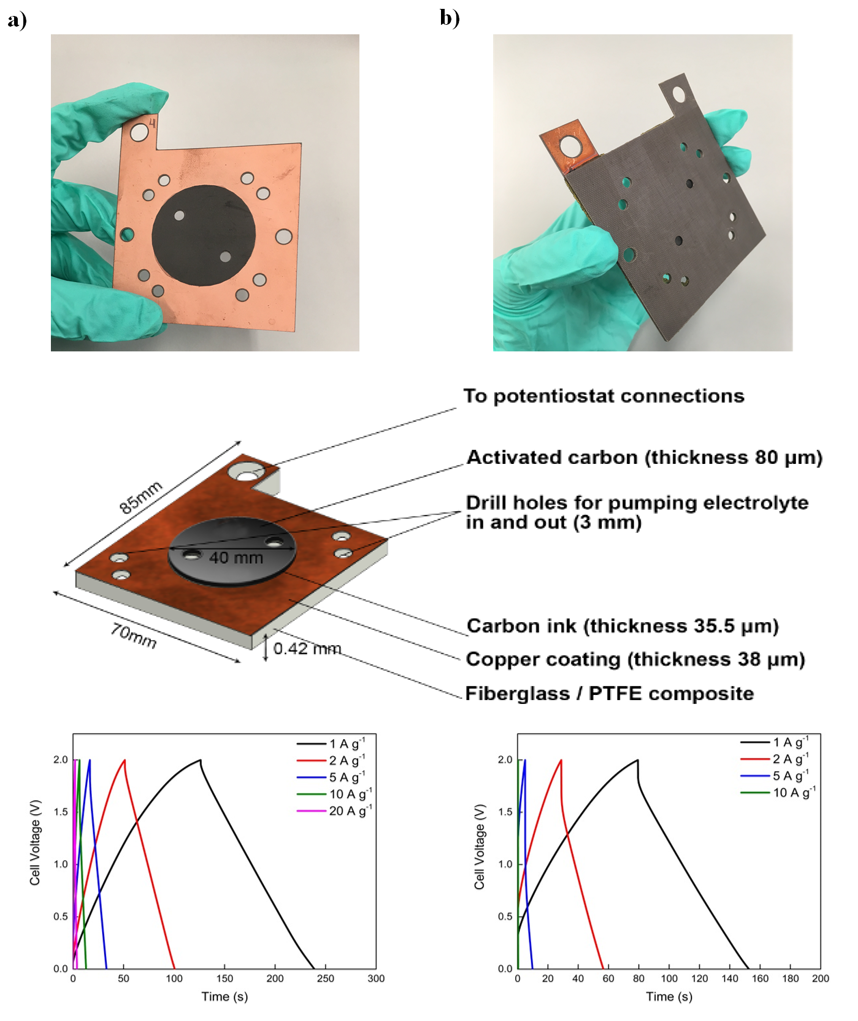
In a collaboration project with UCL, Dina Ibrahim (UCL) has developed a supercapacitor integrated into a printed circuit board. Read the full article here.
Physically integrated energy storage devices are gaining increasing interest due to the rapid development of flexible, wearable and portable electronics technology. For the first time, supercapacitor components have been integrated into a printed circuit board (PCB) construct. This proof-of-concept study paves the way for integrating supercapacitors into power electronics devices and hybridising with PCB fuel cells. Commercial Norit activated carbon (NAC) was used as the electrode material and was tested in two types of electrolytes, sodium sulfate (Na2SO4) aqueous electrolyte, and Na2SO4-polyvinyl alcohol (Na2SO4-PVA) gel electrolyte. Electrochemical measurements compare the SC-PCBs to standard two-electrode button-cell supercapacitors. A volumetric energy density of 0.56 mW h cm−3 at a power density of 26 mW cm−3 was obtained in the solid-state SC-PCB system, which is over twice the values acquired in the standard cell configuration. This is due to the removal of bulky components in the standard cell, and/or decreased thickness of the overall device, and thus a decrease in the total volume of the SC-PCB configuration. The results show great potential for embedding supercapacitors into PCBs for a broad range of applications. In addition, further advantages can be realised through close physical integration with other PCB-based electrochemical power systems such as fuel cells.

Ana Jorge was invited last Thursday 5th July to give a seminar at IMDEA Energy in Madrid. She talked about low cost materials for energy and introduced latest results on the new biomass-derived electrodes for redox flow batteries, as part of her recently granted CAM-IES project.
Maria has recently join the group as a PDRA to develop new electrodes for redox flow batteries within the framework of a project funded by CAM-IES. Welcome Maria! You can find more information about her here.

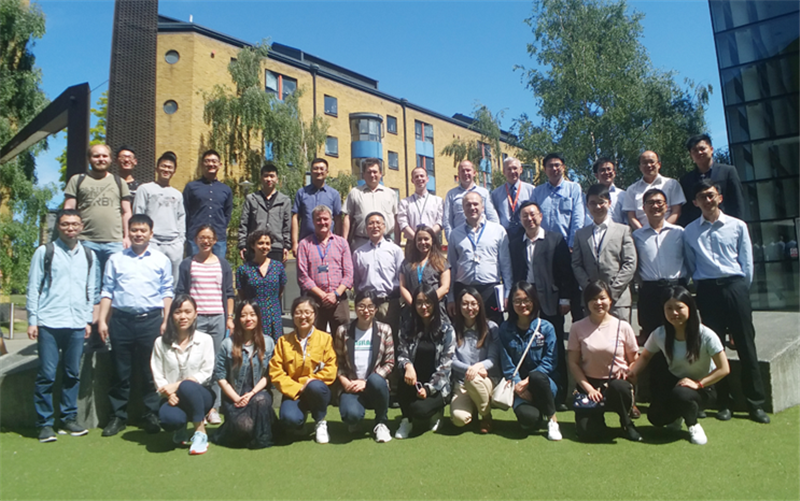
Here a picture of some of the participants in the NPU-QMUL Summer School and Workshop in Energy Nanomaterials taken place from 11th to 15th June at QMUL. Thank you for a great event and hope to meet again soon, next time in Xi’an.